Server-Side Request Forgery (SSRF): Mechanics and Prevention
What is SSRF?
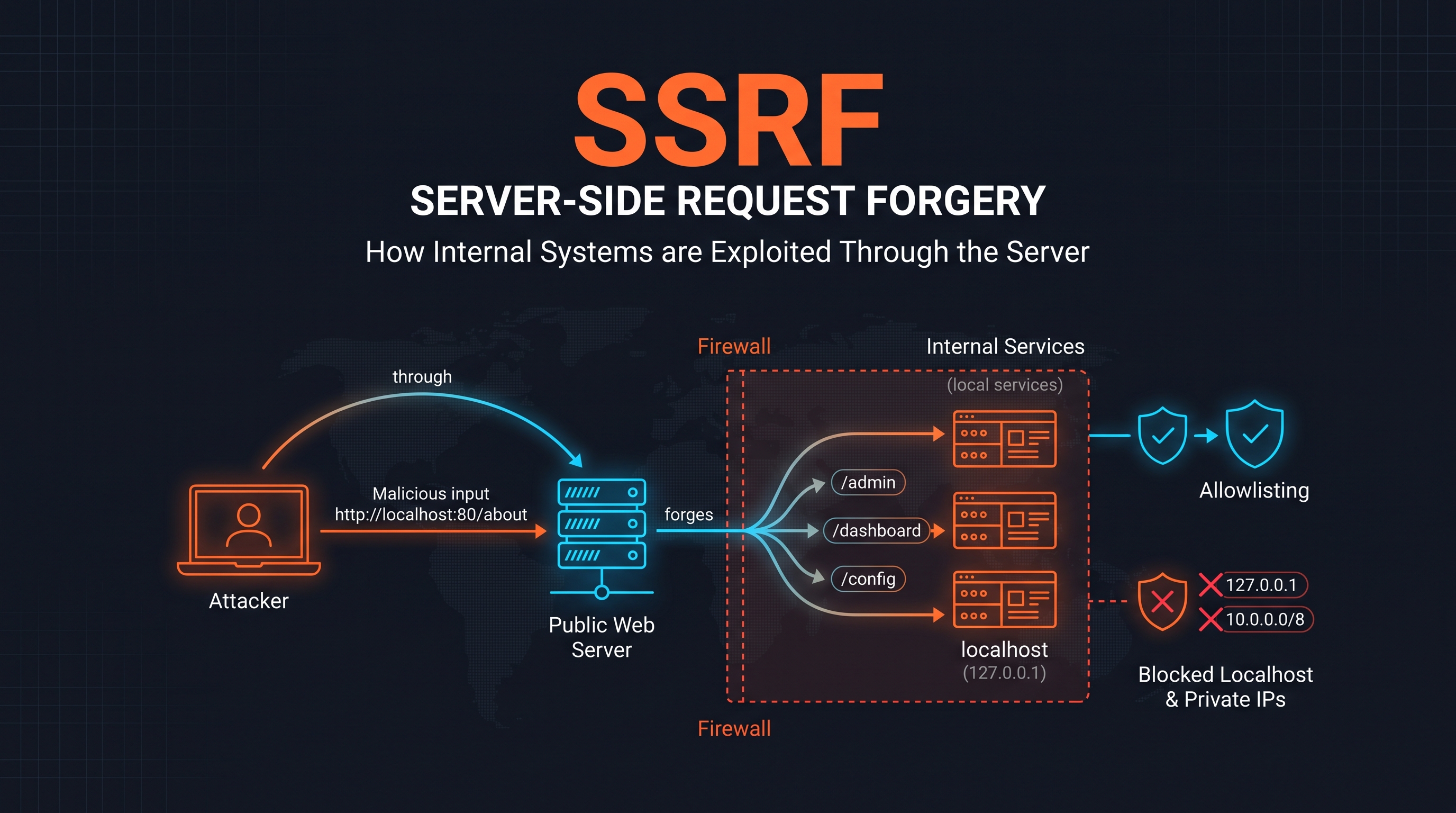
Server-Side Request Forgery (SSRF) is a security vulnerability that allows an attacker to induce a server-side application to make HTTP requests to an arbitrary domain chosen by the attacker. In a typical SSRF attack, the vulnerable server acts as a proxy to access internal systems hidden behind firewalls.
How the Attack Works

If an application accepts an external URL input without proper validation (for example: http://localhost:80/about), the server may process the request internally. This can grant unauthorized access to internal services that rely on trust relationships:
/admin— Internal administrative panels/dashboard— Monitoring dashboards/config— Configuration and environment metrics
Internal infrastructure often omits authentication for requests originating from localhost (127.0.0.1), which attackers exploit to bypass perimeter security.
Remediation and Defense Strategies
- Allowlisting: Restrict outgoing network connections to explicit, pre-approved domain names.
- Block Localhost & Private IPs: Reject requests targeting
127.0.0.1,localhost, and RFC 1918 private IP ranges (e.g.,10.0.0.0/8,192.168.0.0/16). - Restrict URL Schemas: Allow only standard web protocols (
http://andhttps://) and disable non-HTTP schemes likefile://,gopher://, orftp://.
Status: The website owners were promptly notified of the vulnerability in accordance with responsible disclosure practices.